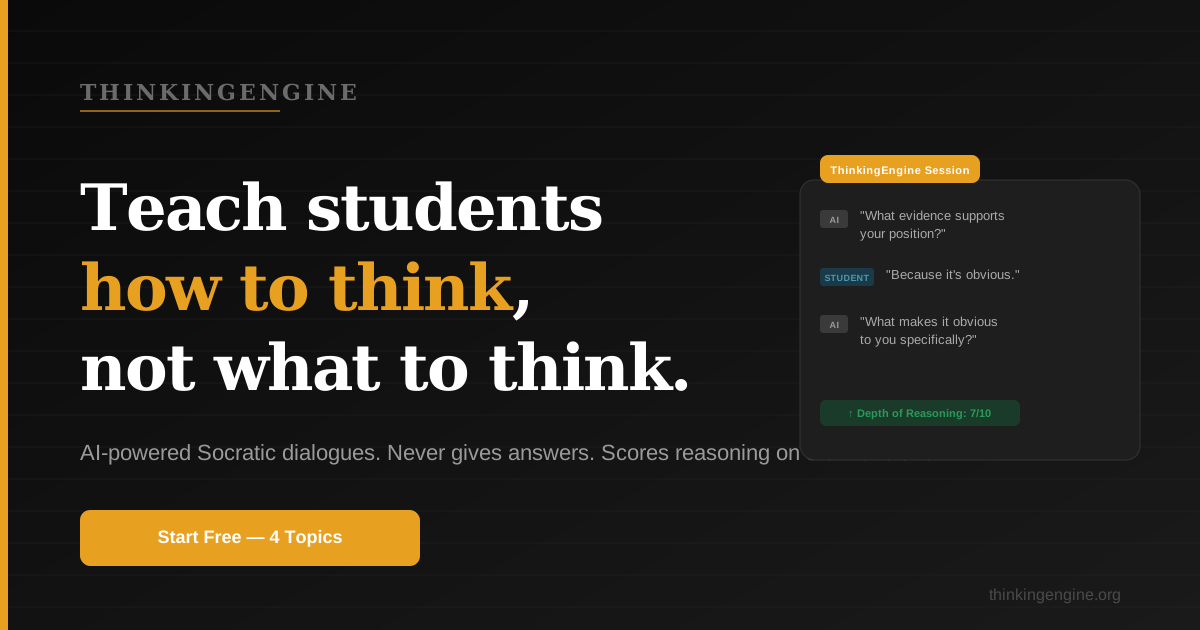
A single overall score on a student's dialogue says very little. A student who scores 8.8 in Evidence and 5.2 in Alternative Perspectives is reasoning differently than one who scores 7 across the board — and the coaching you do on Monday should be different for each. ThinkingEngine scores every Socratic session across five reasoning dimensions, and the breakdown matters more than the composite.
The canonical, durable home for this rubric is the scoring guide. This post is the teacher-friendly primer: what each dimension actually measures, what a passing turn sounds like, and which TpT prompts you can run in your classroom to train each one.
1. Evidence Integration
Does the student bring relevant facts, data, or examples to support their claim — and acknowledge when evidence is missing?
AI: Some people argue that remote work makes employees more productive because they're happier. Do you agree?
>
Student: I disagree. The studies I've seen show mixed results — some show productivity goes up, some show it goes down, and most of them depend on the type of job. I don't think we can say happy employees are always more productive without knowing what kind of work they're doing.
A passing turn cites something concrete and qualifies the kind of evidence it's drawing on. A failing turn either cites nothing or treats a single source as if it settled the question.
Train it with: IB Theory of Knowledge prompts — "Knowledge and Technology" (the Wikipedia question, which forces students to distinguish information from knowledge).
2. Alternative Perspectives
Does the student acknowledge other viewpoints, explain why a reasonable person might disagree, and weigh the competing considerations?
AI: You said schools should teach only academic skills, not life skills. What's the strongest argument against that?
>
Student: A parent might say that the whole point of school is to prepare kids for life, and academic skills alone don't do that — kids need to know how to manage money, communicate, and live with other people. That's a fair point. But I think they underestimate how much academic learning already builds those skills.
A passing turn names the opposing view in its strongest form, not as a strawman. A failing turn dismisses alternatives with "but I disagree" or treats them as obviously wrong.
Train it with: IB Theory of Knowledge prompts — "Knowledge and Society" (whose-knowledge-counts question, which makes students articulate who gets epistemic authority and why).
3. Logical Consistency
Does the student's position follow from the evidence without internal contradictions, leaps, or hidden shifts in meaning?
AI: Earlier you said free-market economies produce the most innovation. But you also said we need strict regulation to protect workers. Aren't those in tension?
>
Student: They can both be true if the regulations are about worker safety and the free market is about the rest of the economy — the two aren't really contradictory because they're operating in different domains.
A passing turn explains why the apparent contradiction isn't one — or admits it and revises. A failing turn just restates the original claim more forcefully, or shifts a term's meaning mid-argument without noticing.
Train it with: How to Run a Socratic Discussion — slow, tenacious follow-ups that surface internal contradictions are exactly what builds this move. See also How to Run a Socratic Discussion (the Journal version).
4. Assumption Identification
Does the student recognize when something is being taken for granted, name it, and consider whether the assumption is actually justified?
AI: You say standardized tests are unfair. What's behind that claim?
>
Student: I think it's because tests assume every student has had the same preparation — same school quality, same home support, same English fluency. But that's not true. So the test is measuring preparation, not ability. The assumption breaks down when you look at who actually has access to good prep.
A passing turn makes an assumption explicit and evaluates it. A failing turn argues the conclusion without ever noticing the premise it depends on.
Train it with: What "Think Critically" Actually Means — the PDF's "what critical thinking actually requires" section is built around this exact move. See also What 'Think Critically' Actually Means (on the Journal).
5. Depth of Reasoning
Does the student trace implications, consider second-order effects, and follow the logic of their position all the way to its conclusions — even uncomfortable ones?
AI: You say math is discovered, not invented. If that's true, where do mathematicians "go" to discover triangles?
>
Student: That's actually a real problem for the discovery view. If mathematical objects exist outside of us, we'd need some way to access them — like a separate realm. Most mathematicians don't really think about it that way. They act like math is a language they construct. But then it's hard to explain how math is true in the same way the physical world is true.
A passing turn follows the implication forward and reports honestly where it leads. A failing turn stops at the first conclusion that feels comfortable.
Train it with: IB Theory of Knowledge prompts — "Knowledge and Mathematics" (the discovered-vs-invented question, which is genuinely hard, and that's the point).
Acting on the profile in your classroom
The five scores together describe a student's reasoning shape. The lowest dimension is usually the most actionable — it tells you which move to coach next, either in a follow-up ThinkingEngine session or in your next whole-class discussion. Read more about how to interpret the score tiers and the Socratic Dialogue vs. Inquiry-Based Exploration rubrics at the full scoring guide.
Related Articles:
- The Question Students Are Afraid to Ask
- How to Give Feedback That Makes Students Think Harder
- How to Measure Critical Thinking Without Multiple Choice
Ready to bring critical thinking into your classroom?
ThinkingEngine guides students through Socratic dialogue — questions that build reasoning, not recall. Free to start, no setup required.
Start Free →