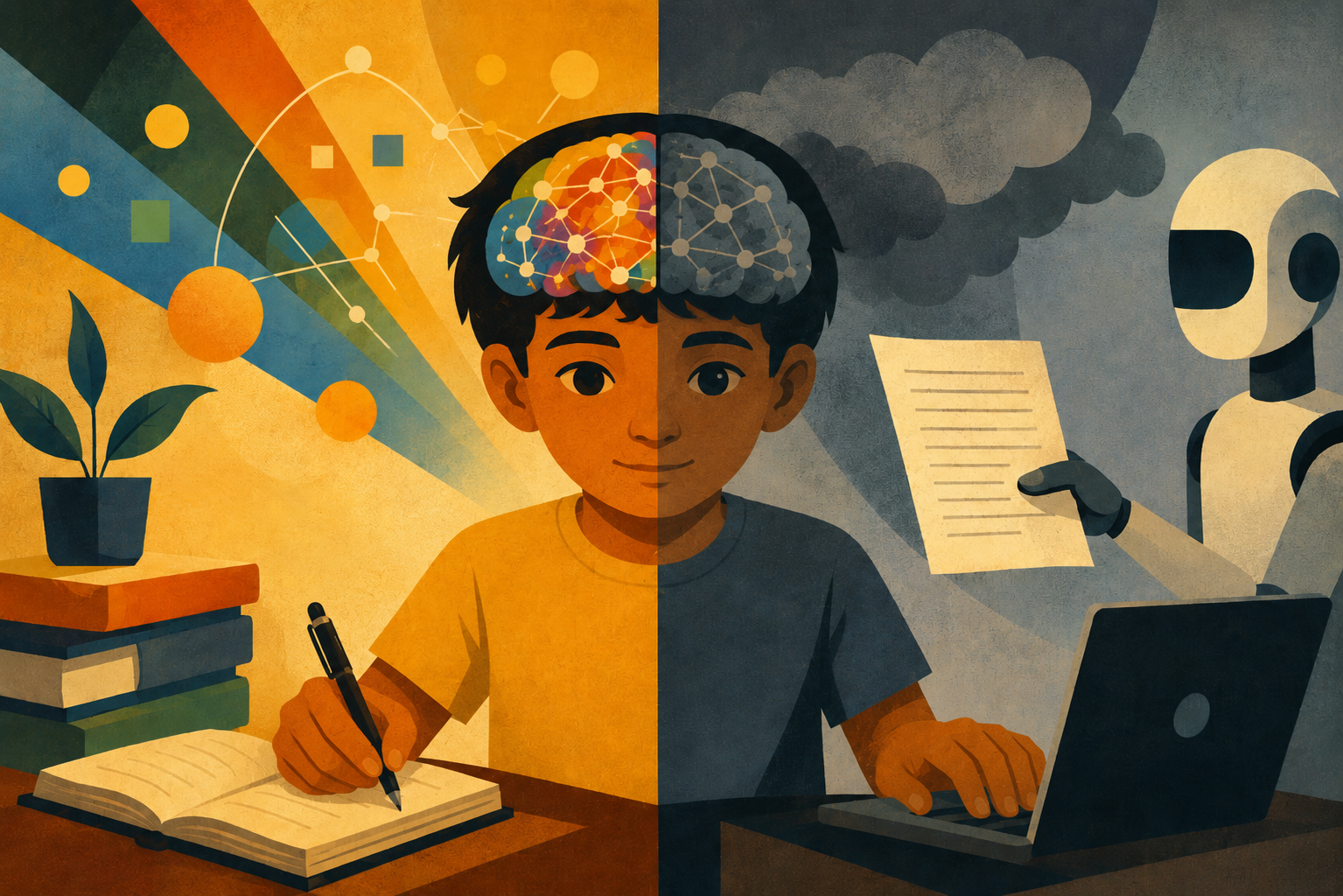
83% of students who used ChatGPT to write essays couldn't recall key points from their own work.
That's from an MIT Media Lab study that put EEG headsets on 54 students and watched what happened inside their brains as they wrote. The search-engine group remembered their work. The no-tools group remembered their work. The ChatGPT group? Mostly couldn't.
This isn't a hit piece on AI. It's a data point parents should know.
What the study actually measured
Researchers from MIT, Harvard, and Wellesley split students into three groups: one wrote essays using only their brain, one used Google Search, and one used ChatGPT. They repeated this three times over four months, tracking brain activity with EEG the whole time.
The results weren't subtle.
Students using ChatGPT from the start showed measurably lower brain connectivity across alpha and beta wave bands (the frequencies tied to focused thinking, memory encoding, and executive function). Their essays looked alike. Two human graders independently called them "soulless." By the final session, many ChatGPT users had shifted from using AI for help to just copy-pasting entire outputs.
Meanwhile, the brain-only group showed the strongest, most distributed neural networks of all three: more cognitive engagement, better recall, more original writing.
The search engine group sat in the middle: more engaged than the AI group, less than the no-tools group.
The recall gap
83% of ChatGPT users couldn't accurately recall key points from essays they'd written just minutes earlier. The brain-only group had high recall. The contrast was stark.
But here's what the headlines missed: when participants switched tools in session four, students who'd used ChatGPT all semester and were asked to write without it couldn't bounce back. Their brains had, apparently, gotten out of the practice of generating.
Students who'd written unaided all semester and then tried ChatGPT for the first time? They showed higher memory recall and stronger occipito-parietal brain activation (the regions tied to sustained cognitive effort).
The order of tool use mattered more than the tool itself.
The "cognitive debt" framing (and its limits)
ThinkingEngine helps teachers run Socratic discussions at scale. See how it works →
The researchers call what they observed "cognitive debt": outsourcing too much cognitive work early trains your brain to stop generating. That's a reasonable hypothesis. But MIT researchers themselves have asked journalists to stop using words like "brain rot" and "dumb." The study involved 54 participants, lasted four months, and hasn't been peer-reviewed. The effects are real. The long-term conclusions are not yet proven.
What's not in dispute: the brain activity changes, the essay convergence, and the recall gap are all directly measured. Focus on the signal, not the sensational framing.
What this means for your kid
Developing brains may be at highest risk (that's from the researchers themselves). When reasoning-through-writing hasn't been practiced, the neural pathways for it don't form as strongly. You can't recall what you never fully processed.
The concern isn't "AI will make kids stupid." The concern is "kids who use AI before mastering the underlying skill may never master it." Think of it like someone who uses a calculator before learning times tables. The answer comes out right, but the multiplication was never internalized.
5 things you can do starting now
- Delay AI tools until after initial skill acquisition. Let your kid write the first draft themselves. THEN introduce AI for editing or feedback. The order matters. It's the difference between supported learning and skipped learning.
- Watch for the copy-paste shift. If your kid's essays started sounding generic or identical to AI outputs, that's a known pattern in the research. A quick conversation about what's happening is often enough.
- Treat recall as a signal. Ask your kid to explain their essay topic a week later without looking at it. Strong recall means the work was processed. No recall means it probably wasn't.
- Make AI a tool, not a co-author. "Help me organize my thoughts" is different from "write this for me." Small shifts in how they use it change what their brain practices.
- Use tools that slow thinking down, not speed it up. ThinkingEngine is built for this. It helps students articulate reasoning step by step, so they engage with the material rather than bypass it.
The MIT study isn't a verdict on AI. It's a data point about how we use it. The kids who learn to work with AI (not through it) will have a different experience than the ones who offload the thinking entirely. That's the conversation worth having at home.
Link to the study: Generative AI Degrades Memory Formation (ACM CHI 2025)
ThinkingEngine helps students slow down and articulate their reasoning, so the work they do actually sticks. Book a demo or start a free trial.
Ready to bring critical thinking into your classroom?
ThinkingEngine guides students through Socratic dialogue — questions that build reasoning, not recall. Free to start, no setup required.
Start Free →